Home / Toilet Repair in Kyle, TX
Plumbing service requests · Kyle, TexasToilet Repair in Kyle, TX
A toilet that keeps running, leaks at its base, or will not clear can waste water or cause damage. Explain the symptom and request toilet repair in Kyle.
Plumbing service available 24/7
Plumbing Kyle service van
Understanding the problemStart with the symptoms you can see
Toilet symptoms can come from several places. One is the tank components. Others are the fixture, the drain, or the connection at the floor. The pattern matters: a single slow flush is different from water backing up into nearby fixtures.
Common toilet problems
Frequent running, weak flushing, and a clogged bowl can each have different causes. So can a loose or leaking base, or water around the supply connection. A toilet that rocks or leaks at its base should be checked rather than repeatedly tightened without knowing the condition.
Prevent an overflow
If the bowl is rising, stop flushing. If the fixture valve is reachable and turns safely, close it. Do not continue flushing to test a blocked toilet. Keep water away from electrical equipment.
Repair or replacement decisions
We can check the fixture and its connections, then explain whether an adjustment, repair, or replacement is appropriate. If several fixtures are backing up, describe that too because the issue may involve a shared drain.
What to report
Mention whether the toilet runs constantly and when a leak appears. Also mention whether the bowl drains slowly, and if other fixtures are affected. This helps distinguish a fixture concern from a broader drain problem.
A useful first stepWhat to do before service
Stop flushing if the bowl is close to overflowing. Turn off the toilet supply valve only if it is easy to reach and operates normally.
For broader plumbing questions and service options, visit our overview of plumbing services in Kyle.
Our process
What our toilet repair visit includes
Toilets are simple machines with a handful of parts. Diagnosing the right one matters, though. Our visit covers the full assembly:
- Complete diagnostic: fill valve, flapper, flush valve, supply line, wax ring, and closet flange. We check everything, because a "running toilet" can be three different problems.
- The usual suspects: constant running is almost always a worn flapper or misadjusted fill valve. Weak flushes point to clogged rim jets or a venting issue. Water at the base means the wax ring seal has failed.
- Repair vs. replace honesty: a cracked tank or bowl can't be safely repaired. And a decades-old water-guzzler is costing you real money on every flush. When replacement makes more sense, we'll say so and quote it upfront.
- Tested before we leave: multiple test flushes, dye check for silent leaks, no rocking, no seepage at the base.
Toilet out of commission? Call (512) 894-6160 — most toilet repairs are done in a single visit.
Toilet keeps running? Start with the checks
A toilet that will not stop running can waste hundreds of gallons a day. The cause is usually one of three tank parts: the flapper, the chain, or the fill valve. Our guide to why a toilet keeps running walks through each check in order, with the water-saving dye test first. If the toilet still runs after those checks, that is when a plumber for a running toilet earns the call. The same applies if the shutoff valve itself leaks when you test it. The fault is in the tank hardware or the supply line, and it will not heal itself. And if you end up replacing the toilet. The EPA's WaterSense program labels models that flush on 1.28 gallons or less. That makes them the efficient choice for a fast-growing city on well and city water alike.
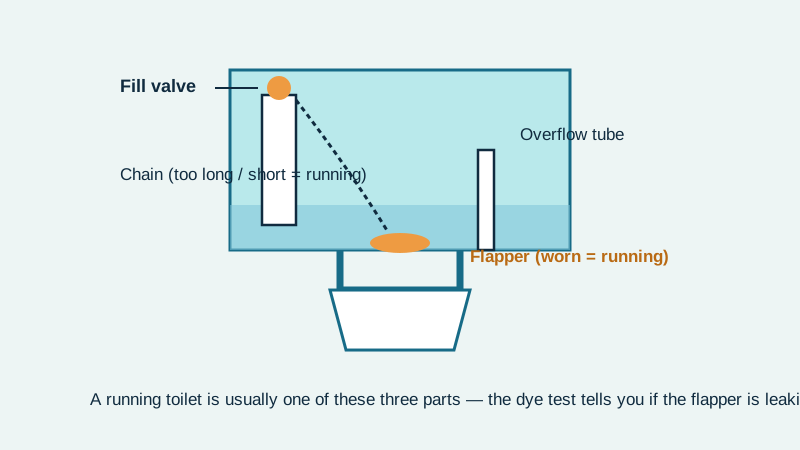
Inside the tank: the three parts behind almost every running toilet.
Toilet Replacement and Installation in Kyle, TX
Some toilets are not worth another repair. Cracks in the porcelain, constant clogging, and rocking at the base all point to replacement. So does a toilet that needs repair calls several times a year.
Modern toilets flush well on 1.28 gallons or less. That is 20 percent below the old federal standard, and it shows on a Kyle water bill. Your plumber removes the old unit and checks the flange and floor for hidden water damage. Then he sets the new toilet, seals it, and tests it before he leaves.
Questions about toilet repair in kyle, tx
Practical answers to common service questions.
Why does a toilet keep running?
The cause can involve a tank component or water level issue, but systems vary. Note whether it runs constantly or intermittently and request an assessment if it persists.
What should I do with a clogged toilet?
Stop flushing when the bowl is rising. Shut the fixture valve if safe and request help if the blockage does not clear or other drains are affected.
Why is water appearing at the toilet base?
The source could be the fixture connection or nearby plumbing. Stop using the toilet and request an assessment, especially if water continues to spread.
When should I replace a toilet instead of repairing it?
A toilet may need frequent repairs, or it may have a cracked tank or bowl. Mineral wear from Kyle’s hard water may also keep wearing out its parts. In any of these cases, a replacement may be worth discussing. Note the symptoms you see and mention the toilet’s history when you request service. That way, the technician can advise on repair versus replacement.
Should I repair or replace my toilet?
Repair suits a toilet that is sound but has a worn flapper, fill valve, or handle. Replace when the porcelain is cracked, the base rocks, or clogs keep returning. Age matters too: parts for very old models can be hard to find. Your plumber will tell you honestly which route costs less over time.
Kyle-specific
Toilet issues common in Kyle
Kyle's hard water is the primary culprit behind most toilet problems we encounter. Mineral deposits accumulate on flush valve seats, flappers, and fill valve mechanisms, preventing proper seals. A toilet that runs intermittently — refilling on its own every few minutes. The cause is almost always a mineral-compromised flapper or fill valve rather than a major malfunction. These are inexpensive parts, but the hard water means they wear faster here than national averages suggest.
Weak flushes in Kyle toilets often trace back to mineral-clogged rim jets. These are the small holes under the bowl rim that direct water during a flush. When half the jets are blocked by scale, the bowl doesn't get enough water velocity for a complete flush. Homeowners sometimes assume they need a new toilet. Often, a thorough descaling of the jets and siphon would restore full performance.